Table of Contents
The Full-Grain Steerhide Standard: Heavyweight Durability
Steerhide represents the benchmark for motorcycle and hardwearing outerwear. Cut from mature male cattle, steerhide features dense, tightly interwoven collagen fibers that yield exceptional puncture, abrasion, and tear resistance.
In its full-grain state (where the outermost natural epidermis remains unbuffed and unsanded), steerhide averages 1.3mm to 1.5mm in thickness (roughly 3.25 to 3.75 oz). When first worn, full-grain steerhide feels stiff, structured, and almost armor-like. Over several months of active body heat and flexing, the hide molds precisely to the wearer's elbow creases and shoulder slope, developing character that machine-processed leathers can never replicate.
Horween Chromexcel: Century-Old Pull-Up Alchemy
Formulated in 1913 by Chicago's famed Horween Leather Company, Chromexcel (CXL) is one of the world's few surviving combination-tanned leathers. It undergoes 89 distinct processing stages over a full month, merging chrome tanning (for tensile strength and elasticity) with vegetable tanning (utilizing bark extracts for richness and firm temper).
Chromexcel is subsequently hot-stuffed with proprietary cosmetic-grade beef tallow, cosmetic oils, and beeswax. This extreme saturation yields a legendary 'pull-up' effect: when the leather is folded, creased, or flexed, the oils displace beneath the surface, revealing striking lighter tonal gradations that shift with movement.
Italian Plonge Lambskin: Butter-Soft Elegance
For urban commuters, formal layering, and lightweight statement jackets, Italian plonge lambskin stands in direct contrast to heavyweight steerhide. Cut between 0.8mm and 1.0mm, lambskin possesses microscopic pore structures that impart an extraordinarily soft, velvety hand-feel with zero break-in period.
While lambskin should not be treated as abrasion gear for high-speed motorcycling, high-grade full-grain lambskin is surprisingly resilient to daily wear. It breathes naturally, folds compactly without permanent creasing, and takes color dyes with unmatched depth and saturation.
Merino Sheepskin Shearling: Cold-Weather Thermal Superiority
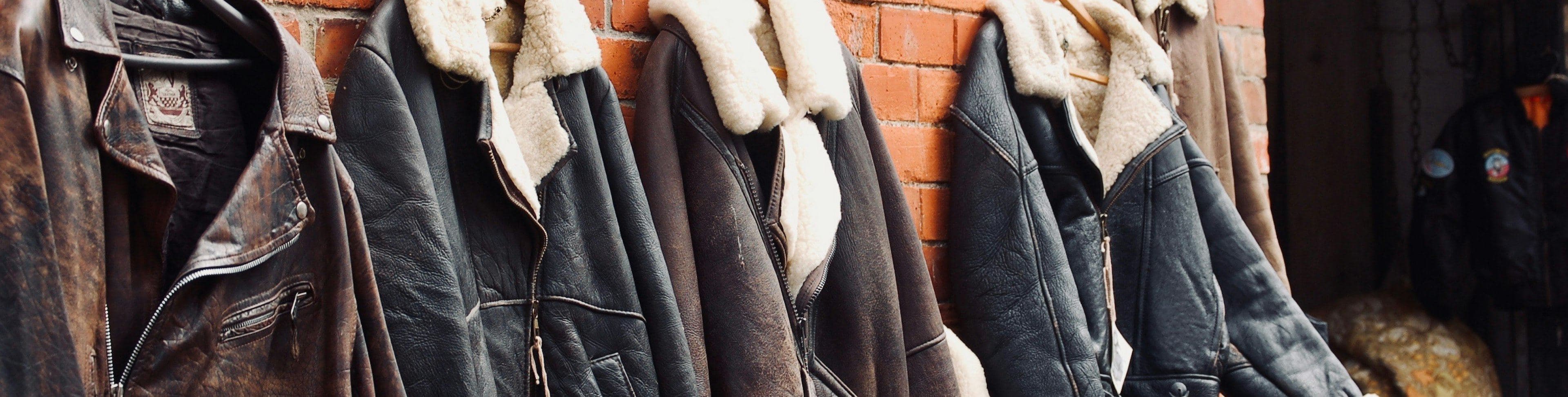
True shearling is not a leather jacket lined with synthetic wool—it is a single continuous pelt of sheepskin tanned with its natural fleece wool intact on the reverse side. The leather exterior forms a windproof barrier, while the dense wool fibers trap millions of microscopic air pockets.
This natural capillary system provides insulation unmatched by synthetic goose-down or polyester fillings, remaining comfortable from -25°C up to +10°C due to wool's moisture-wicking and thermoregulating properties.
Material Comparison Matrix
Compare hide specifications side-by-side to determine which leather matches your climate and lifestyle:
| Hide Type | Thickness | Temper | Break-in Time | Thermal Rating | Primary Strength |
|---|---|---|---|---|---|
| Full-Grain Steerhide | 1.3 – 1.5mm | Firm & Structured | 30–60 wears | Moderate | Maximum abrasion & longevity |
| Horween Chromexcel | 1.2 – 1.4mm | Medium Supple | 15–30 wears | Moderate to Warm | Spectacular pull-up patina |
| Italian Lambskin | 0.8 – 1.0mm | Ultra-Supple | Instant (0 days) | Mild / Transitional | Silky lightweight comfort |
| Merino Shearling | 15 – 22mm fleece | Soft Heavy Cushion | 5–10 wears | Extreme Sub-Zero | Superior thermal insulation |
Arthur Thorne
Master Leather Artisan & Tanner Consultant
Specializing in vintage outerwear curation, leather tannage forensics, and made-to-measure outerwear construction at the Leather Haven Craft Atelier.